
Indonesia
June 4 through June 23, 1997
Indonesia is huge, consisting of 13,000 islands stretching almost 5,000 km from the Asian mainland into the Pacific. According to the guidebooks, it takes at least four months to reasonably visit all of the major islands. We only went to two islands: Bali and Lombok, which make up only a very small part of Indonesia. What we didn't see was much more than what we did see.
Worries from Back Home
On our way to Indonesia, Lauren called her mother from Singapore and told her we'd just left Cambodia. As of then, Cambodia hadn't been on the news in the US (although this would change in a few weeks) and so our visit in Cambodia hadn’t worried her. But Indonesia had just had elections and there had been some rioting in Jakarta. And this had been reported on the news back home, which made her worried about us going to Indonesia.
If Indonesia's corrupt ways had never started to make their way to the White House, none of this would have been newsworthy in the US. We had never thought twice about going to Indonesia but had thought a lot about going to Cambodia. It was an example of the incomplete view of the world you get from back home, probably no matter where back home is.
Bali
Ubud
The first night, we arrived at the airport in Denpasar and headed straight to Ubud to meet Dave and Catriona, who were friends from London. They'd just gotten married and were honeymooning in Indonesia, and through the magic of email, we'd arranged to meet in Bali. Ubud also sounded cool, both figuratively and literally. It’s the cultural and art center of Bali, and also inland up in the hills where the evenings are cool.
The ride up to Ubud from the airport confirmed what we already knew, that Bali is a very heavily populated and developed island. We couldn't see much in the dark, but we heard a lot of gamelan music as we passed through villages and the island seemed both more exotic and more modern than we'd expected. Because we got to Ubud at night, we'd made reservations at Sayan Terrace, which we'd mostly picked because it was the cheapest place in our guidebook that listed a telephone number, and after Singapore, we didn't want to look around late at night for a place to stay. It was a little expensive at $25 per night. When we got there, we found that it was also very posh – a huge, nice room and an upholstered couch, easy chair, and a dining table and chairs on a big terrace. In the morning we woke to a view of vivid green palm forests over a gorge with a river below. Our original plan was to find something cheaper after the first night, but we ended up staying there for four nights because it was too good a place to leave.

Entrance to Sayan Terrace

Terrace at Sayan Terrace
Ubud is very developed, but it has developed well. The buildings are attractive, full of charm and character and unlike the rest of Southeast Asia, sidewalks that you can actually walk on. Unlike the rest of Southeast Asia, the land is well-tended and beautifully landscaped. Bali is famous for its stone carving, and carved stone adorns almost everything, old and new, the buildings themselves, walls, gateways, and statues. In many ways, Ubud reminded us of San Miguel de Allende (the city in Mexico where Geoff's parents live), but cleaner and more prosperous and in a tropical setting.
Ubud also has some of the best accommodation values in Asia. There is a huge selection of guest houses, nearly all of them in pretty garden settings with views of the rice paddies and great restaurants at every price category. Add this to the surrounding countryside of terraced rice paddies and river gorges, and it was obvious why it's such a popular tourist destination.
It is also the shopping capital of Bali. There is a lot to buy -- batik clothes, wood carvings of everything from masks to monkeys and Komodo dragons, baskets, paintings, and, of course, t-shirts. Ubud has such a large population of artists that we wondered how they all could make a living. We planned to return to Ubud before heading home, as it was an ideal place to buy presents for friends and family. It also seemed to be a convenient and enjoyable place to spend the last few days of the first half of the trip.
Monkey Business in Ubud's Monkey Forest
In the morning, we hooked up with Dave and Catriona and headed to the Monkey Forest, where almost 150 monkeys live in three different groups. Barely inside the woods, there was one group by the side of the trail demanding to be fed. This first group was the forest's dominant group. They'd staked out the primo spot by the entrance where all of the tourists (including us) enter freshly laden with bananas and peanuts that vendors sell you just before you go in.
These monkeys were not shy and would climb on you to go into your bags and pockets looking for food. They weren’t friendly though and if you tried to them, they would bare their teeth and hiss. The monkeys were all over the place: big ones, small ones, short ones, tall ones, and even small babies. Except for baring their teeth and hissing, they did all of the things you'd expect of monkeys – they looked cute, they swung from trees, they ran and jumped and scampered around. (Except they didn't sit there and scratch under their arms and say "ooh-ooh-ooh").
Of course, we decided to take some pictures of ourselves with monkeys on our shoulders. This was easy: you hold a banana up over your head and a monkey will climb up you’re your shoulder, grab the banana, and then sit on your shoulder and peel the banana and eat it. (This was not a wilderness experience.)

Inside the Monkey Forest

They are really cute at first...
Everything was going as planned, and we were merrily snapping away, when one monkey noticed Dave's sunglasses perched on his head. The monkey grabbed the sunglasses and jumped off. Then he sat on the ground trying to put them on. He'd obviously seen enough so that he understood the concept, but he was having problems with the execution. He put them on backwards, forwards, and upside-down, and a bunch of other ways, most of which were close but none of which were right.
At first, we thought this was hilarious and assumed that the monkey would quickly get bored and drop the glasses. But no, the monkey apparently decided that this complex problem needed more careful consideration from a better spot, which was high in a tree above us. We think he chose this spot because it was the best place to amuse us, and also to torture Dave, who, after about ten minutes of this, started muttering, "Hey, gimme back my Ray-Bans!" This didn't work, so Dave grabbed the tree and started shaking it. The monkey didn't like this and hissed at Dave. Dave went back to muttering and gazing skywards towards the monkey and his sunglasses.

Just a little big

Dave looking up at monkey and sun glasses
The monkey, for his part, had given up trying to figure out how to put on the sunglasses. But this didn't mean he'd lost interest in them. He chewed on the stems for a while and then put them around his waist, which was a perfect fit and climbed higher to the top of the tree for more stem-chewing. Dave muttered a lot more while the rest of us laughed. But it was also time for more desperate measures. The brochure for the Monkey Forest mentioned that on-site "monkey experts" were available, so Dave went to try and find one.
While Dave was gone, we got the break we needed. Nearby, a monkey bit a kid, the kid flung the monkey off his shoulder, and the monkey shrieked. This attracted the attention of most of the monkeys, including ours, who dropped the sunglasses amidst the excitement. Without a moment's hesitation, the monkey came sliding down the tree to retrieve the glasses, but they fell at Catriona's feet and she got them first. The monkey came at her, hissing, and she tossed the glasses to Geoff. Geoff stuffed them into his pocket and yelled at the monkey, who was now approaching him. The monkey gave up, and the sunglasses rescue mission was complete.
Just as this ended, Dave came back alone saying that the monkey expert wasn't going to help. Geoff gave him his sunglasses back, and he noticed that the stems were not only chewed but also noticeably shorter! Dave muttered some more, and we left to get lunch. At lunch, Dave kept looking at his newly customized sunglasses and muttered more and more.
Bird Watching in Petulu
According to our Lonely Planet guidebook, thousands of herons nest in trees lining the main road of Petulu, a small village north of Ubud. Lonely Planet uses the word "spectacular" twice in its description: "the spectacular sight of thousands of herons arriving home in Petulu" and "spectacular sight as they fly in and commence squabbling over the prime perching places." If anything, Lonely Planet books can be pretty dry, so if these birds warranted two spectaculars, then it must be, well, spectacular.
The book said the birds arrived in the late afternoon, so we found a taxi driver to take us there at about 4:30. Looking back on it, our first hint that the birds might be less than spectacular came from our driver. Yes, he knew where they were, and sure, he could take us there, but he did seem a little bit puzzled about why we'd want to go. In much of Asia, people tend to overrate their local attractions, and they don't hesitate to go on and on about how great they are. Not this time. No build-up whatsoever. But maybe he had read Lonely Planet and knew that nothing he could say would outdo their description.
Our second and more obvious hint was when we arrived in Petulu. Our driver stopped the taxi on a nondescript main street of a little town. We asked if this was the right place and he said yes. We got out, not completely convinced, and asked someone at a small shop on the sidewalk. He said yes, too, but also cracked up laughing and pointed up at the trees. The woman running the store then told us that the birds came in at six o'clock, which was over an hour away. We figured, okay, we were there a little early, and the birds would arrive soon enough. But why was the guy laughing so hard just because we were early?
We noticed that the road, the bushes, the buildings, and the car in town were covered with bird droppings. This was just the proof we needed to wait. We hunkered down on some steps, bought some drinks, and waited. We noticed that there were already some herons in the trees above us and a few more flying around. This was yet more proof that this was not a complete fraud. Although we were growing more and more skeptical, we were still hoping for a scene out of "The Birds," where the sky would darken as thousands of herons came home to roost.

Waiting for the herons
So we stayed and waited. After a while, some herons did actually arrive, and a few actually did squabble over perching spots. But the arrivals were numbered in groups of about five to 20 – not quite the horizon-obscuring flocks we'd expected. The only real excitement was that Dave got bombarded by heron droppings, which, after his morning with the monkeys, somehow seemed fitting. Our boredom turned into silliness, and our laughing probably convinced the villagers, who'd been watching us constantly and coming over to chat from time to time, that we were having a great time. Catriona convinced us to stay until six, which we did. We then left, leaving behind one of the lamest spectacles we'd ever seen.
The Mother of All Attractions
The next day, we rented a jeep and went to Gunung Batur, which is a large volcano inside of an even bigger caldera. On the way, we went to Pura Besakih, which according to Lonely Planet is "Bali's most important temple," and "comprises 30 separate temples in seven terraces up the hill, all within one enormous complex." This description never uses the word "spectacular," but it still sounded impressive. It is also Bali's "Mother Temple," which we took to mean "The Mother of All Temples." Again, we were ready to be impressed.
We got there, parked the jeep, paid our fees, and duly read the rules about proper dress and proper etiquette. The last rule was "Mensturating” women are forbidden from entering. This is standard for Hindu temples, and actually applies to any kind of blood – if you have an open wound you're not supposed to enter either. But it does make you wonder: how do they know? Do they check, or can they just tell? It seemed to be an honor system, but would a Hindu god would strike a woman dead if she entered while menstruating, or would she just go to Hindu hell?
After pondering these weighty questions on the walk up the hill, we arrived, and there it was. What Lonely Planet had said was true: there were 30 (mostly unimpressive) temples and it was enormous, but mostly in a sprawling way. But it all failed to impress. We tried to be fair and figured that after the temples of Thailand and Angkor Wat, maybe we'd become a bit jaded. Then Dave and Catriona said they weren't impressed either.

Pura Besakih

Prayers at Pura Besakih

Dave & Catriona at Pura Besakih
It was clear that we were on a roll – first the herons, then the mother temple. We could hardly wait for the next stop, which was Gunung Batur. For this, Lonely Planet only used the word "spectacular" once. Was this a good sign or a bad sign? By now we'd started calling Lonely Planet "Lousy Planet," and were understandably doubting our one source of information. Most of the Lonely Planet books are excellent. However, for Indonesia, Moon Publication's Indonesia Handbook, was considered to be by far the best guidebook for Indonesia. (However, we couldn’t get it because the government had banned it due to its unflattering descriptions of the Suharto regime and other government issues.) We think LP conceded to Moon and didn't put as much into this one as they do others.
Beyond the mother temple, we finally got into some of Bali's more rural countryside, and the beauty that Bali is famous for is very real. It is a green, lush island of tropical forests and rice fields with rolling hills, huge volcanos, and incredible views. We finally arrived at the top and got our first view of Gunung Bator. It truly was spectacular.

Gunung Bator

Lake Batur
Driving in Indonesia
Indonesia is like Vietnam in that the roads are used for everything from driving to storage to workshops. Vehicles move at all speeds and there are no shoulders so pedestrians have nowhere to go to get out of the way. Honking the horn is the standard way to get slower vehicles and pedestrians to get out of the way. According to the guy at the rental company, the only rule was "no beep, no go," by which he meant, "just keep honking your horn whenever you're moving."
On our way to Lake Batur (a lake in the shadow of Gunung Batur), Geoff was so busy avoiding obstacles in the road that he blasted past the entry gate to the national park, where we were supposed to stop and pay a fee. We didn't realize this until we heard whistles blowing and saw three guys come running up behind us. Uh-oh, we thought Geoff was about to receive a hefty fine for driving without an international license. But fortunately, they approached the car in a friendly manner, and the cop stuck his head in the window and asked, "Where are you from?" When we replied that two of us were from America, he was eager to show off his vast knowledge of the U.S., and, with a big smile on his face, said: "Mi-am-i? Flo-ri-da? Mich-ael Jor-dan?" We enthusiastically said, "yeah, yeah, yeah," paid our fee, and were on our way.
Night driving was more like a video game, with obstacle jumping out at you at the last minute: dodge the piles of wood carvers' wood and piles of dirt, bricks, and stone, realize that the bridge is only a single lane wide even though there's still a center stripe, and avoid running over too many pedestrians, dogs, and bicycles. Geoff's parents had always warned him against driving at night in Mexico. "It's too dangerous, there are cows in the road, people driving with no headlights on, etc." But they never warned him about not driving at night in Indonesia. We did it, and we survived, and now driving in Mexico at night will seem like a breeze (although probably not a good idea).
Things that Go Bump in the Night
Between Lake Batur and Ubud, there are two villages that specialize in wood carving. By the time we got there, it was dark, and most of the shops were closed for the day. We reached one area where a few places were open, and we stopped to look around. The places we went in had some interesting things but basically sold the same stuff we'd already seen in Ubud.
Before long, three of us were ready to go, but Dave went wandering off down a dark side alley. The last time he'd gone wandering off, he'd come back with bird droppings on his shoulder. We wondered what would he come back with this time?
We waited, and when he hadn't come back after a few minutes, we went to look for him. Dave had found a wood carver whose shop was closed, but who was willing to show us his work, and his work consisted of skeletons. He carved plain skeletons (life-sized), coffins for the skeletons, as well as other skeleton trinkets: skeleton ashtrays, skeleton coat racks, skeleton chests of drawers, pretty much anything you could think of, he made in a skeleton motif. At one point we saw his family in a room, watching TV. He kicked them out so we could see all of the other skeleton carvings he had stacked in there.
There was nothing threatening about the guy, but here we were in a building off a dark alley in the middle of nowhere. We hadn't seen any of this stuff in Ubud, and here we were surrounded by skeletons Who was this guy? Did he have some kind of obsession with death? Would our families read a newspaper article reporting two British and two American tourists killed in Bali in some kind of Satanic ritual involving skeletons? We left without incident, and without making any purchases, but we did wonder about the market for his work.
Lombok
Lombok is the island directly east of Bali and was supposed to be like Bali "twenty years ago," meaning less developed and unspoiled. It's easy to get between the islands, and we took the slow ferry which took about five hours.
When we got to Lombok, we headed to the so-called "Gili Islands," which are just off of Lombok's northwest coast. A bus took us from the ferry terminal to the small town of Bangsal, where we caught a small boat to Gili Air. As soon as the bus left the terminal, it was clear that Lombok was different that Bali. Bali is modern, developed, and firmly entrenched in the "Second World." Lombok, on the other hand, is still very Third World. Very little, if any, of Bali's prosperity has spilled over into Lombok, and the closeness of the two islands made the differences in the standard of living stark.
The Gili Islands
The Gili Islands are comprised of three small oval islands: Gili Trawangan, Gili Meno, and Gili Air. ("Gili" is Indonesian for "island," so calling them the Gili Islands is redundant, but that's what they're called in English.) Gili Trawangan is the busiest of the three, and known as the party island, while the other two are very quiet and peaceful. We wanted to go to one of the quieter islands, and for no particular reason chose Gili Air.
One of our hopes for Indonesia was to find an idyllic beach like we found at Thong Nai Pan in Thailand, check into a beachside bungalow, hang our hammocks, and relax for a while. From the shape of Gili Air, we knew that we wouldn't find a perfect crescent-shaped beach, but we had high hopes for the rest. But after a quick look at a number of places, with no luck, and with night falling, we checked into a place called "Legends." The bungalows were decent but set too far back from the beach. We'd find another place the next day.
As we took the room, we noticed the sun setting over the ocean. We threw our packs into the room, went back out, ordered a beer, and watched the tail end of the sunset from a table set up on the beach. Even if we hadn't found the place we were looking for, and intended to move, we had found the perfect spot to watch the sunset, and we returned there every night to watch it.
The next morning, we walked around the island. Gili Air is small, oval, and flat, and you can walk around it in about an hour. It's surrounded by a coral reef and a thin beach. About 600 people live there, which is a lot for its size, but it is still very quiet and peaceful. There are no cars and instead you get around by walking or by horse cart. The people who live there make their livings mostly off of the tourists or by farming seaweed on the sandbar inside of the reef.
From just about any perspective, Gili Air was a great place, and if it had been one of our first stops, we would have fallen in love with it. But the beaches didn’t compare to Thong Nai Pan in Thailand and there weren't any bungalows right on the beach. We were starting to get jaded. As it was, we checked into the Fantastik Bungalows, which had a view of the water, one hammock already hanging, and, after a little experimentation, room for another. The bungalows weren't quite "fantastik," but they were nice, run by a very friendly family, and the breakfasts were great. We spent four relaxing days there, and Lauren shifted pretty easily into relaxation mode. As for Geoff, he was hanging around on an island in Indonesia but feeling more and more that if we were just going to be hanging out, he'd rather be in Vermont in a short but sweet New England summer. The same feeling was growing in Lauren, but she was still content on Gili Air.

Gili Air bungalow

Gili Air taxi
In spite of our attitudes, Gili Air was a memorable stop. We saw the best sunsets of the trip, and the snorkeling was the best of the trip – lots of coral, some blue, and tons of fish of all sizes and shapes. Most nights, we hung out with Didi and Yogi at Legends, drinking beer and playing chess. Geoff won 2 of 3 the first night and then lost 3 of 4 the last night. Geoff asked them if they played chess a lot. They said, "yes, every night, because there's nothing else to do."

Gili Air boat

Lauren on the beach
Is There a Future?
Talking to Didi and Yogi, and other experiences over the next couple of days, Lombok started to get a little depressing. Most of the places we'd been on the trip, no matter how they were, were getting better and people were optimistic about the future. But not on Lombok. Things don't seem to be improving, and by the looks of some of the newer buildings, may be on a downhill slide. There are too many people with not nearly enough education with nothing to do and without expectations that things will change.
This and the poverty on Lombok were especially striking coming from Bali, where there is so much prosperity. Some of the markets we saw on Lombok were as poor as those in Cambodia, and horse carts are still a major means of travel. The horse carts may sound quaint, but they're not. Most of the time they are out on paved roads with cars, trucks, and buses blasting by.
There is also a growing frustration. A huge proportion of the population is young, and there is nothing for most of them to do. But they all know how corrupt their government is and that the rich are getting richer and that Lombok is not. Throughout the world, it seems that governments can get away with being corrupt if they are either so repressive that people can't fight back (like China and Burma) or if living standards are rising fast enough so that corruption is overlooked (like Thailand). Neither of these seems to be the case in Indonesia, and you can't help but wonder how long things can keep going the way they are. In spite of the news reports in the U.S., Indonesia, or this part of it anyway, doesn't seem ready to explode, but the growing frustration has got to lead to something.
Kuta Lombok
On Bali, Kuta is a big tourist beach area notorious for its Australian surfer scene, and it's heavily developed and crowded. On Lombok, there is also a Kuta, but so far, it is still undeveloped. Lonely Planet calls it "a magnificent stretch of white sand and blue sea with rugged hills rising around it, but not much else." This sounded pretty good (and there wasn't a single "spectacular" in the description). Maybe this would be the beach we were looking for that could rival those in Thailand.
When we arrived in late afternoon, it appeared that Lonely Planet had finally gotten it right as the beach really did look magnificent! Up close, tit still looked great. Then we tried to walk on it and our feet sunk into the sand up to our ankles. We tried walking a few steps and it was like walking in dry quicksand. On close inspection, the problems became clear: every grain of sand was a perfect sphere. We were walking on "billions and billions" of ball bearings, all of which tried to roll away when we stepped on them. We tried walking closer to the water and it was the same.
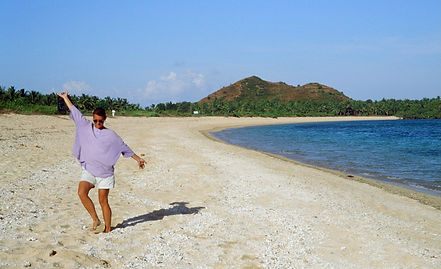
Lauren on Kuta Beach
After struggling down the beach a way, we gave up and went back out onto the street to walk. Back past our hotel, the pavement ended and we came to the village of Kuta. Like too much of Lombok, it was very poor and there were too many people, too many kids, and too many dogs all hanging around with nothing to do. The village was as depressing as the beach was beautiful.
Mohammed the Junior Hustler
One night, as we were finishing dinner, an Indonesian kid came up to our table and asked if he could sit down and talk with us. This happens a lot, and people want to do this mostly to talk, but also to sell you things. This kid's name was Mohammed, he was 14, and had lots of things to sell, but primarily magic mushroom omelets (for 5000 rupiahs, or $2.10). Business was slow and he settled in to talk to us. In his own language, he couldn't read or write, but the English he'd learned from talking to tourists was excellent. After a while, we asked him if he ever got into trouble selling mushrooms and he said, "yes, I got caught once and had to do a month." Later, he told us his aspirations: to learn to write, to fly on an airplane, and to go to Australia.
Every so often, new customers would come in and Mohammed would hustle off to try to sell them one of his omelets. Mohammed was having a slow night (he never did sell an omelet that night) and always returned to our table. We wanted to leave the next day and asked if he could arrange a ride for us to the Tetebatu, where we were heading next. We knew the answer would be yes, and of course that’s what he said. His uncle had a van and could drive us. "How much?" Geoff asked. "50,000 rupiahs [$21]," Mohammed responded. Geoff said, "No, that's way too much," and we went back and forth for a while. Finally, we told him we'd talk to his uncle after breakfast tomorrow and if we could agree on a price, we'd go with him. Then, before Mohammed left for the night, he did one more set of rounds. The restaurant had closed for the night, and if anyone wanted a bottle of water, he'd run down the street to get some. We got some, as did others, and he made 20¢ on each bottle.
Talking to Mohammed that night made Lombok more depressing. Mohammed was a kid who was smart enough to teach himself English, German, and Japanese from talking to tourists but couldn't write and had become a hustler. His aspirations were simple but probably unattainable for a kid from Kuta. Most of the time he was still a kid, and when he talked about going on a plane, his eyes lit up like a kid's. But he was also old and wise enough to know that there was nothing for him in Kuta and there was no legitimate way to escape. So here he was selling magic mushroom omelets so that someday he could fly on a plane.
By day, the hotel wouldn't let the locals inside, and in the morning, when we went for breakfast, a line of peddlers had formed across the hotel entrance. Among the peddlers was Mohammed, standing there smoking a cigarette. He beamed when he saw us and waved us over. He introduced us to his uncle and pointed across the street to a van. We agreed on 35,000 rupiahs and that we'd leave at 9:00.
Mohammed hung around outside for the whole hour and a half until 9:00, when his uncle returned. After we loaded our luggage and ourselves into the van, Mohammed jumped in and said he was going with us for the ride. Although Tetebatu was only an hour away, he'd never been there and wanted to see it. Mohammed the hustler, but one who'd made good on all of his promises, was gone, and, for the time being, was replaced by Mohammed the kid who wanted to go for a ride and see a little of the world beyond Kuta.
Tetebatu
Unlike Bali, which is mostly green and lush, Lombok is mostly very dry. But as we drove toward Tetebatu, we entered the rain shadow of Gunung Rinjani, which at 3726 meters, is Lombok's tallest volcano. Once again, we had returned to a wet tropical landscape, and arrived at Tetebatu, which is located on Rinjani's lower flank where the rice fields end and the forest begins.
We stayed at the Soedjono Hotel, which used to be a doctor's mountain retreat. After he died, it was turned into a hotel. Since then, new rooms and bungalows have been added haphazardly, and the hotel had the air of a place that had seen better days. It had a swimming pool that was cracked and missing tiles, no furniture, and surrounded by a chain link fence. The pool wasn't very inviting, but our bungalow was pretty nice, and the surrounding area was beautiful.
In and around Tetebatu, our major activity was going for walks, mostly through rice paddies and forests. As in Bali, the rice fields were terraced, and we walked along the tops of the dikes that separated the different levels.


Rice paddies in Tetebatu
Most of the walks we did with guides. Here, they were useful because they knew how to get through rice fields we would have gotten lost in. Wannabe guides are everywhere and our first one attached himself to us as we were walking. He started with the typical talk of "where are you from? what are your names? I want to practice my English," etc. Then we came to a point where there was a path off to the left and he asked, "do you want to see a small waterfall and a panorama?" In Asia speak, this means "do you want me to be your guide and if you say yes you'll have to pay me." We said yes, and off we went through the rice fields and down into a small gorge to see the waterfall., which was actually quite picturesque, and a beautiful view over rice paddies towards the south.


Walks and views in Tetebatu
The next day we hired another guide to take us to a bigger waterfall. We got this guide surreptitiously. He snuck up to our room and offered a much better price than the hotel wanted. He made us promise not to tell the hotel, and the next morning, we met him a little way down the trail. This waterfall, the Jukut Waterfall, is billed as one of the major attractions in the Tetebatu area. But like other Asian waterfalls that are billed as major attractions, it really wasn't, and the journey there was much better than the destination. We hiked through a countryside of hills, small gorges, terraced rice fields, and higher up, mahogany forest. Too soon we arrived at the waterfall, which was a long flume of water spilling into a small pool surrounded by trash.
The Only Good Beer in Indonesia
Our last night in Tetebatu, we went for a beer at a place that advertised "Anker Stout." After nothing but Budweiser-like Bintang, regular Anker, and Bali-Hai, we were dying for a good beer, and this was the only prospect in town. The stout was only so-so, but tasted good after all the other Indonesian beer, and we ended up eating there and then hanging out with the guys who ran the place. Like many of the guys on Lombok, one fancied himself as a singer and guitar player and soon started playing songs. And like most of the others, his guitar playing was pretty good, but his singing wasn't. The first song was Indonesia's perennial favorite: "Hotel California," but sung as "Hotel Tetebatu." And everyone else's singing was so bad, Geoff even sang along.)
It turned out this was the only place we ever found Anker Stout. So, if you're in Indonesia and want to drink decent beer and sing in bad harmony to "Hotel Tetebatu," go there. We never did notice the name, but Tetebatu is small, and you can recognize it from the "Mad River Glen, Ski It If You Can" bumper sticker that is now out front.)
Back to Bali
Back to Ubud / Trapped in Paradise
Tetebatu back to Ubud was a day of travel: first by bus to Materam, then a bus to the ferry, then the ferry to Bali, and finally another bus to Ubud. We were returning to Ubud to buy gifts for friends and family back home, and to change our plane tickets to an earlier flight back to Vermont. Although Bali and Lombok were beautiful, they were similar to other places we'd already seen, and we'd been on the road a long time. We were also getting to the point that the deciduous forests of Vermont were beckoning stronger than the tropical paradise of Bali.
Our shopping expeditions were very successful, and we found nearly all the stuff we wanted to get. The downside of this was that we were no longer traveling light and now felt very laden down (we bought so much stuff that we even bought some bags as gifts so we'd have something to carry the other stuff in).
After all the shopping, we went to a travel agent to change our flights. The guy at the agency asked when we wanted to leave and we said June 20th. He called Garuda Indonesia, and after some conversation we couldn't understand, told us the flight was full. "Well, how about the 21st," we asked. That was full too. Then we asked when the next available flight was. He told us nothing before our scheduled departure on the 30th. We asked about waiting lists and he checked that out and said that the waiting lists were averaging 60 people a day. We got on the waiting lists for the 22nd and 23rd, but knew our chances weren't good.
So here we were, wanting to go home but unable to. It was frustrating, but also kind of funny. Many people consider Bali to be paradise, and we joked that it looked like we were trapped in Paradise. We also knew we'd better not call anyone at home looking for sympathy. Bali was truly a wonderful place; we were just burned out on traveling at that point and were anxious to be in one place for a while.
Sanur
In case we got lucky and actually made it onto a flight, we headed down to Sanur, which is heavily touristed beach area in Denpasar only about a half hour from the airport. We figured we'd give the waiting lists a few days and if that didn't work, we head to Java to climb Mount Bromo.Sanur was the Bali’s first big tourist area. Now it's just one of many, and in many respects, it has been passed by other areas that are much newer and fancier. It's mostly a mishmash of a lot of different things: many self-contained resorts interspersed with a few cheap places, local restaurants, and local markets, all fronting a mediocre beach. There also many Indonesians there, both to sell things to the tourists and to enjoy the beach for themselves. There was really very little of Indonesia there, and this was a resort area of packaged vacations that could have been anywhere.
Of all the places we'd been, Sanur was one of the most disappointing and even if we hadn't been anywhere else, we probably still wouldn't have liked it. One night there was more than enough, but long enough to find out we hadn't made the next day’s flight. There was still a chance for Monday, so we stayed two nights.
Kuta Bali
Kuta is Bali's biggest resort area notorious for its Australian surfer dude scene. Everyone claims to hate it – it's too crowded, too overdeveloped, and too much of a hassle, which of course is because everyone still seems to go there. We figured we'd better too or we might miss something. Kuta has also spilled over into the neighboring town of Legian, where there was a new Internet cafe. It had been a while since we had checked e-mail and if we were going to be stuck here, we figured we should check up on it. It also gave us a semi-legitimate reason to go to Kuta.
After over an hour of searching, we finally found the cybercafe, which was so new that everyone kept assuring us that it didn't exist. While Lauren was checking email, Geoff went to make our daily call to Garuda. Once again, we hadn't made the next day's flight. But on this call, he was told that the problem was the Honolulu to LA segment and that there were seats from Jakarta to Honolulu. Then his time was up and the phone disconnected.
When Lauren heard we hadn’t made the flight again, she said, "well, then I guess we go to Mt. Bromo." Then Geoff told her that the problem was the Honolulu to LA segment and asked her if she wanted to try to go to Hawaii. Lauren started to think of reasons why we shouldn't, and then stopped, and she smiled and said "Hawaii?" It was time to move on, and we decided to try to catch tomorrow's flight to Hawaii.
Afterwards, we spent what was to be our last night in Indonesia walking down the beach from Legian to Kuta. Like the area, the beach was crowded, and there may have been more people here than all of the other beaches we'd been to combined. But the reason for it was also clear. It was an incredible beach with long, huge rolling surf. Lauren said they were "TV waves" because they were as perfect as the ones that surfers always seem to be riding on TV. Looking at the waves, it was obvious why Kuta had become a Mecca for surfers. And beyond the waves, Kuta wasn't that bad. Most of the knocks on it were true, and away from the beach it has been overdeveloped without much thought or planning. In this respect, Kuta is like a lot of beach resorts everywhere, and compared to places like Hampton Beach on New Hampshire's seacoast, it's not so bad.
Indonesia in Retrospect
Looking back on Bali and Lombok, we should have gone there at the beginning of the Asian portion of our trip instead of the end. Indonesia would have been a great introduction to Asia. Bali is as beautiful and interesting as everyone says it is. But with the exception of Ubud and all the stone carving, we'd seen better versions of what Bali had to offer in other places. The beaches were better in Thailand, the terraced rice paddies more dramatic in Nepal, and we'd seen beautiful scenery almost everywhere. Of course, we were suffering from an attitude problem, and there really wasn't anything to complain about – Bali is a great place to visit.
Lombok, overall, was disappointing. It is beautiful, but so are so many other places. In Lombok, the poverty coupled with the appearance that things were getting worse, and the frustration of so many of the people, made it depressing in a way that other places weren't. The proximity and prosperity of Bali probably also helped fuel this feeling.
At the same time, as we write this, we're also aware of how much our attitudes can color our opinions of places. Coming here, we probably misjudged what we were looking for. After Thong Nai Pan, we thought it would be nice to end the first half of the trip lazing on a similar beach on Bali or Lombok. In doing so, we set an ideal that the two islands couldn't live up to, and then to make it worse, we figured out that if we were just going to laze around, then Vermont would be better than the beach.
In retrospect, we shouldn't have started out looking for a place just to hang out at – Thong Nai Pan just happened. We should have just kept doing what we'd been doing most of the time, which had been traveling to places that seemed interesting as well as beautiful. In the end, we didn't enjoy Bali and Lombok as much as other places, but we also probably didn't give it a fair chance either.
Quotable Quotes
"Mi-am-i? Flo-ri-da? Mich-ael Jor-dan?"
– Cop who pulled Geoff over after running through a park entrance station impressing us with his knowledge of the US
Indonesia Maps


Indonesia Links
For more information on Cambodia::
Lonely Planet Indonesia: The 1995 guidebook that gave us “spectacular” advice.
1995 Moon Handbooks Indonesia Guide: Information on Moon Handbooks 1995, which was considered the definitive guide to Indonesia but hand been banned in the country when we were there due to its honest descriptions of Indonesian politics and the Suharto regime.